
Guide · Rendering
Monocouche or sand and cement? What a Dorset elevation actually needs.
By KCL Interiors Limited. First published April 2026, revised September 2026.
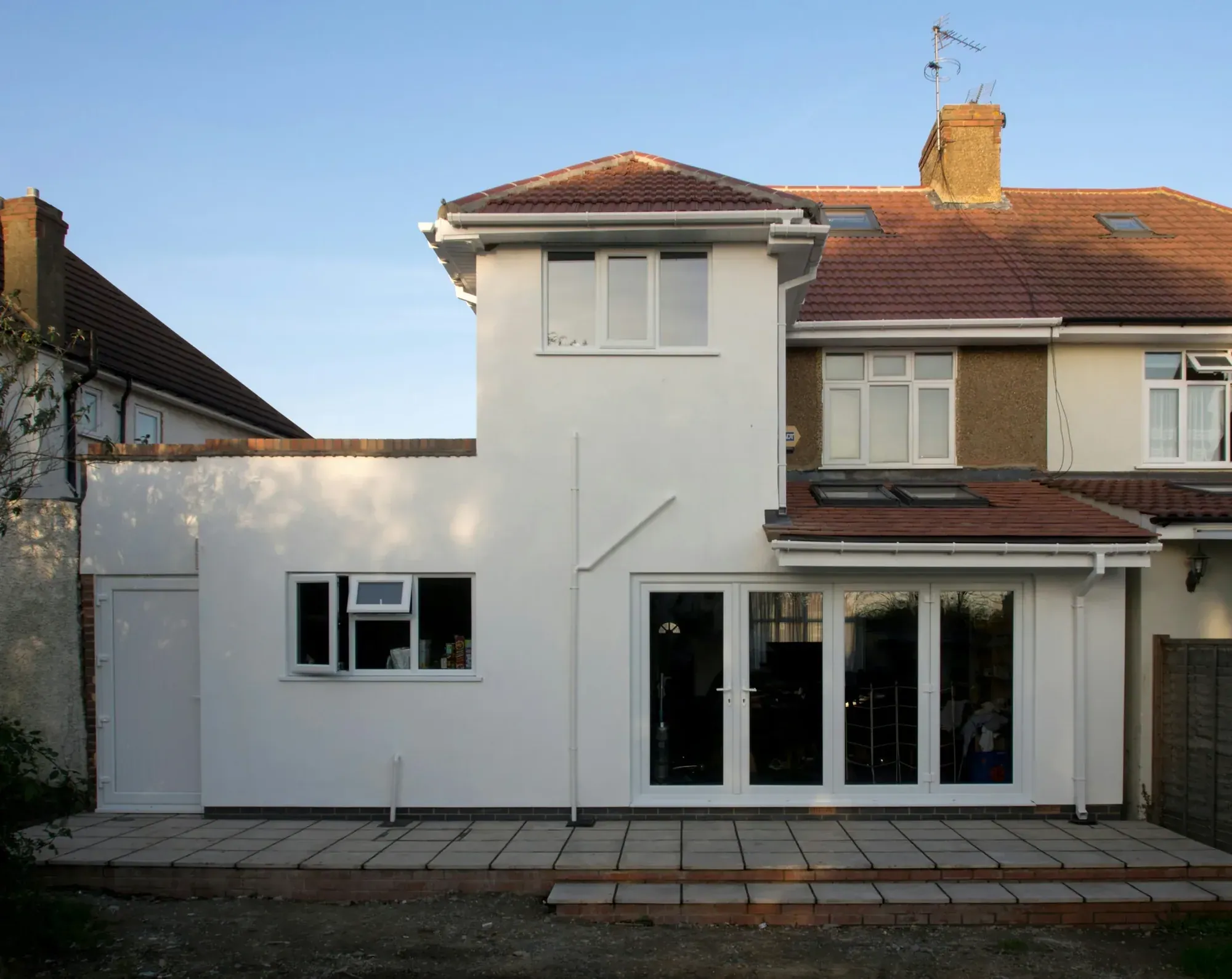
Three quotes on the kitchen table. One says monocouche, one says sand and cement, the third just says render and a number. The builder recommends one, the neighbour swears by the other. Here is what we would say standing on the drive.
Two systems, two different jobs
Both go on the outside of the house, both keep the rain out, both make a tired elevation look new. That is where the similarity ends.
Sand and cement is the one your grandfather would recognise: mixed on site, applied in two or three coats, painted once it has cured. Monocouche arrives as a factory-batched powder, goes on in a single pass, and has its colour running all the way through.
Monocouche
Monocouche means single layer. It is mixed with water on site and applied in one pass over a prepared substrate, then scraped or textured. The colour is in the material, so a chip or a pressure wash in ten years shows the same colour underneath.
The headline is that it is never painted. No masonry paint lifting in strips after a Dorset winter, no scaffold every few years so a decorator can redo what the weather undid. The render is the finish. Most of the sharp-edged new houses along Sandbanks and East Cliff are monocouche.
It costs more per square metre than sand and cement on the day it goes on. Spread over the years it is not repainted, the comparison changes.
Sand and cement
Sharp sand, cement, water and usually some lime for flexibility. A scratch coat to key into the wall, a float coat for the finish, sometimes a third for a particular texture, then a wait of several weeks before paint.
More labour, because of the multiple coats and the curing between them, and a lower material cost. The range of finishes is wider: smooth, roughcast, pebbledash, tyrolean. If a 1930s semi in Southbourne should look the way it did when it was built, this is how it gets there.
The catch is maintenance. A painted render is repainted on a cycle, and near the seafront the cycle is shorter.
Side by side
- CoatsMonocouche one. Sand and cement two or three.
- ColourMonocouche through-colour, never painted. Sand and cement painted after curing.
- MaintenanceMonocouche an occasional wash. Sand and cement repainted on a cycle, shorter on the coast.
- Time on siteMonocouche faster. Sand and cement longer, with curing between coats.
- Best forMonocouche: new builds, full re-renders, exposed coastal elevations. Sand and cement: period houses, conservation areas, textured finishes, repairs.
A table cannot tell you what we see standing in front of the house: where the rain hits hardest, what the substrate looks like under the old render, whether the wall needs a full strip or a patch. That is what changes the answer.
On the Dorset coast
Salt air gets into paint film and lifts it from underneath. Wind-driven rain hits south-facing walls across Sandbanks, East Cliff and the harbour front for months at a time. Then summer heats the wall, winter cools it, and the cycle repeats.
Monocouche handles it well because there is no paint to fail. Sand and cement works on the coast too; walk any street in Boscombe or Southbourne and you will see it on houses that have stood for eighty years. But the repainting comes round sooner.
Inland, in Wimborne, Ferndown or Blandford, the weather is gentler and sand and cement makes more sense more often. And there is the heritage question: a Victorian terrace in Westbourne with smooth painted render looks right. The same terrace in a modern scraped finish looks wrong, even if you cannot say why.
And silicone
Silicone render is monocouche’s tougher relative: through-colour, with silicone binders that shed water faster and keep the surface cleaner for longer. It costs more again. For the house on the corner that takes the prevailing south-westerlies head on, it is often the right answer.
How to choose
Monocouche if
- You never want to repaint.
- It is a new build or a full re-render, not a patch.
- You want the clean, modern look of the newer houses along the coast.
- You are within a mile of the sea.
Sand and cement if
- The house is period and a traditional painted finish is right for it.
- You are in a conservation area that wants traditional materials.
- You need roughcast, pebbledash or tyrolean.
- The budget needs to stay lower on the day and you are happy to maintain it.
Silicone if
- The elevation takes the worst of the weather every year.
- You want a surface that stays cleaner without scrubbing.
- You will pay more now to forget about the render for decades.
Or ask us to look. We check the substrate, the exposure, the age and style of the building and the condition of what is there, then say what we would do if it were our house. We apply all three systems and have no reason to steer you to one.
The wrong render shows up in three years, not three weeks: hairline cracks, paint in sheets, damp on the inside face. We have stripped enough of other people’s to know the cheapest quote and the right quote are rarely the same piece of paper.